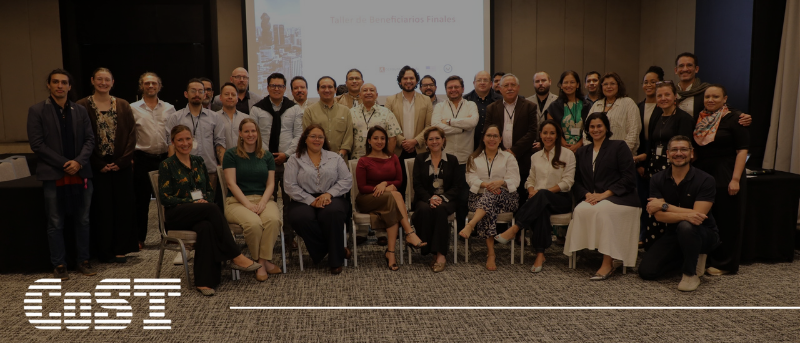
Last week, CoST – the Infrastructure Transparency Initiative, Accountability Lab and the Center for Advanced Defense Studies (C4ADS) brought together government, civil society, private sector, technology and data experts from Panama, Ecuador and across Latin America to explore how data and emerging technologies could strengthen transparency in public infrastructure.
The Beneficial Ownership and AI Workshop built on work with CoST’s local partners in Panama and Ecuador, which identified gaps in the availability, accessibility and use of beneficial ownership information in infrastructure. The focus was practical: how can procurement and ownership data be connected, verified and turned into information that can help people understand who is behind the companies delivering public infrastructure?
A key focus was connecting public infrastructure contracts, the companies delivering them, their beneficial owners and, where available, the countries of origin of both companies and beneficial owners. This information is often held across different datasets, making it difficult to establish these connections and use them to understand infrastructure markets and identify potential risks.
The workshop’s multistakeholder approach was central to tackling this challenge. Government officials, civil society organisations, private sector representatives and technology and data practitioners brought different perspectives on how beneficial ownership data can be used in infrastructure.
“This workshop brought together highly skilled experts from Ecuador, Panama and across the region, which made for robust conversations and tangible ideas on how data transparency can move infrastructure work forward. It was also good to see meaningful engagements between civil society professionals, the private sector and technologists that highlighted the different incentives groups hold related to data usage.”
Cheri-Leigh Erasmus, Co-CEO and Chief Learning and Agility Officer, Accountability Lab
Over three days in Panama City, participants worked with national and international datasets and explored tools to help connect infrastructure contracts, companies and their beneficial owners. Training was also provided on investigative techniques for working with different data sources, and guidance on using AI responsibly and transparently. Participants then developed and refined potential data platforms around their own use cases, considering the technical and policy challenges and the needs of the people who would use them.
“Participants learned about available data options and designed data platforms for their own use cases, carefully weighing the technical and policy challenges, users, and use cases involved.”
Mollie Zapata, Senior Director of Analysis, C4ADS
For CoST, the workshop showed how this process can help turn complex ownership information into something more practical for infrastructure transparency.
“For me, one of the most rewarding aspects of this work has been seeing how our local partners in Panama and Ecuador have taken complex information and turned it into something that can be used to better understand who is behind the companies delivering public infrastructure. Connecting public works contracts with beneficial ownership data is not simple, and the progress made reflects the commitment and knowledge of the people working with these data in each country. This is an important step towards making beneficial ownership information more practical and useful for infrastructure transparency.”
Evelyn Hernández, Technical Director, CoST
The workshop was supported by a grant from the US Department of State.