CoST guidance helps current and prospective members to implement each of the four features of the CoST approach: disclosure, assurance, multi-stakeholder working and social accountability. Our resources set out the key requirements, questions and steps that those responsible for developing a CoST programme need to consider, however they can be utilised by any government or entity wishing to promote more transparent infrastructure locally.
Open Government Guidance Note

This resource builds on our work with Open GovernmentPartnership. It supports those involved in the formulation and implementation of OGP commitments, whether through Action Plans or the Open Gov Challenge, who would like to engage with and draw on CoST expertise. Available in English, Spanish, Portuguese and French.
Engaging the British Embassy in your country

This guidance note focuses on making the case for building a partnership with the British Embassy in your country, and sets out a series of practical steps on how to do this. It includes success stories from members who have done just this. Available in English and Spanish.
Climate finance guidance note
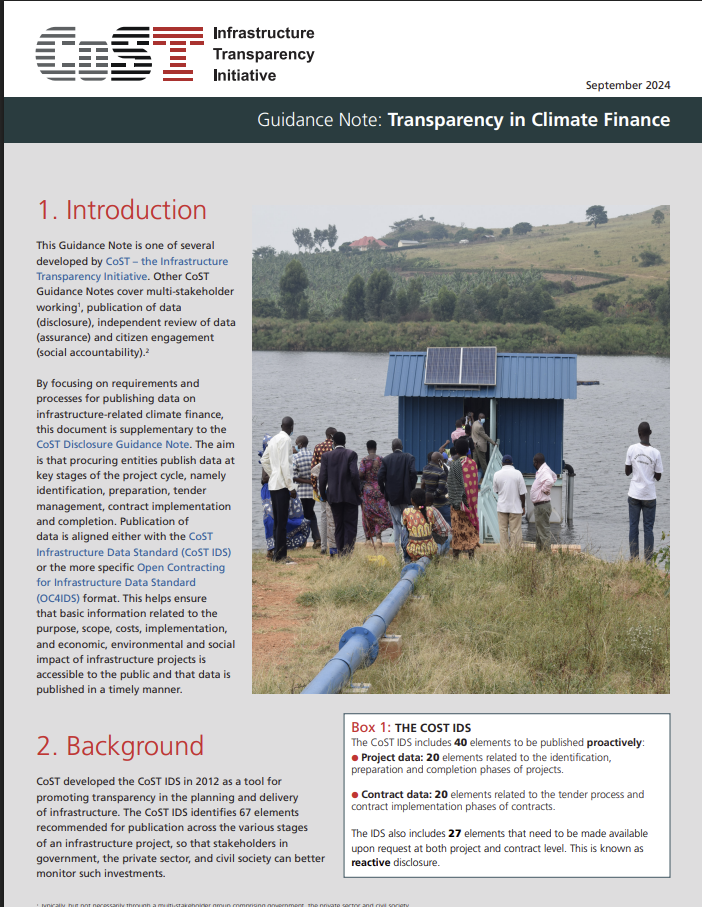
This guidance note sets out the importance of climate finance, key questions around climate finance investments, our new data points and how they can be used by all procuring entities – inside and outside of CoST’s membership.
The resource has been developed and created with the support of German Agency for International Cooperation (GIZ).
This new module is developed to further infrastructure transparency, accountability and participation while enhancing sustainability, adaptation and resilience to climate change.
Guidance Note: Scoping Study
This latest addition to the suite of CoST Guidance Notes sets out the objectives, tasks, approach and reporting requirements necessary for undertaking a Scoping Study in support of a potential or actual CoST programme.
The scope and depth, and hence time and budget, required of a Scoping Study will depend on the circumstances under which it is undertaken. In every case, however, it serves to clarify whether, and if so how, the CoST approach can realistically be expected to contribute to systematic improvements in governance of the public infrastructure sectors or sub-sectors under consideration. It provides a baseline for transparency in the infrastructure sector and sets out the current how the government, the private sector and civil society currently participate in the delivery of public infrastructure.
The Guidance Note, together with associated Excel tools, serves as a basis for both for conducting a Scoping Study and for developing Terms of Reference that will suit the local context.
Guidance Note: Mainstreaming Gender Equality

Over recent years CoST has increased its focus on promoting greater gender-equality across its member programmes and the infrastructure sector. This includes promoting more equal representation in the composition of member secretariats, the multi-stakeholder groups that guide programme delivery and the assurance teams members work with to put key infrastructure issues in the public domain. Importantly, members have also amplified the voice of females in their civic engagement activities. This has promoted female empowerment and ensured the project issues that negatively impact women are brought to light. Our Guidance builds on this work and shows how a gender-inclusive approach can be incorporated across the core features of the CoST approach in data disclosure, assurance multi-stakeholder working and social accountability.
Data Publication Manual
The Data Publication Manual provides practical guidance for establishing and strengthening infrastructure data publication processes. It supports procuring entities and CoST programmes to publish reliable, timely and accessible data using infrastructure data standards, including the CoST Infrastructure Data Standard (CoST IDS) and Open Contracting for Infrastructure Data Standard (OC4IDS).
The manual covers a range of topics, including the use of existing CoST resources, public-private sector partnerships, sustainability and climate finance modules, and water-related data points. It also includes practical tools such as example mandates, worksheets and process-mapping tools to help stakeholders strengthen data publication.
Data Use Manual
The Data Use Manual provides guidance on using and interpreting infrastructure data to improve monitoring, reporting and decision-making. It includes practical examples across different project phases and risk areas, helping stakeholders turn published data into useful insights and action.
The manual covers key performance indicators, dashboards and risk indicators, as well as areas such as value for money and market opportunities. It is designed to support a range of stakeholders, including journalists, oversight authorities and independent review teams.

Guidance Note: Improving infrastructure transparency, participation and accountability during a crisis
This Guidance Note outlines how to prioritise and fast-track the implementation the CoST approach during a crisis, without necessarily becoming part of a recognised CoST programme. Such an approach not only helps to reduce risks associated with the procurement of public infrastructure during a crisis, but also lays the foundations for more lasting reforms. Prepared during the Covid-19 pandemic, this resource is intended for use by decision-makers who may not already be practising CoST’s four core features but who recognise the potential relevance of each such feature. Read more.
Also available in French, Portuguese and Spanish.
Independent Review Manual. Volume 1
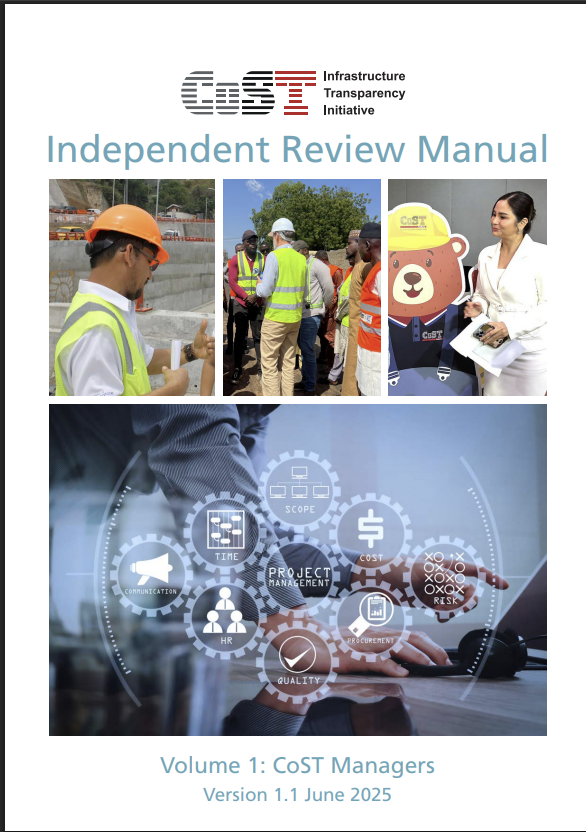
The Independent Review Manual, Volume 1 provides practical guidance on carrying out independent reviews of infrastructure project data. Independent review is a core CoST feature that assesses the accuracy and completeness of published data and helps turn it into accessible information, highlighting issues of concern and examples of good practice.
The manual outlines the key steps involved in planning and carrying out an independent review, including reviewing project information and preparing findings that can support greater accountability and improved infrastructure delivery.
Independent Review Manual. Volume 2
The Independent Review Manual, Volume 2 provides further guidance and practical support for implementing the independent review process and producing findings that are credible, evidence-based and useful to stakeholders.
Together, the two volumes support CoST members and others working to strengthen infrastructure transparency to carry out robust independent reviews, communicate findings effectively and use evidence to promote better performance and accountability in the infrastructure sector.
Guidance Note: Establishing a CoST Multi-Stakeholder Group
The CoST approach to multi-stakeholder working brings government, private sector and civil society together in pursuit of a common goal. This is typically achieved through the establishment of a Multi-Stakeholder Group (MSG) comprising representatives of each stakeholder group. This guidance note outlines six core steps to form and deliver a multi-stakeholder group that works efficiently together and with the secretariat of a CoST member programme. Read more.
Also available in Spanish.
Guidance Note: Social Accountability
 The CoST social accountability feature helps ensure that the data disclosed and turned into compelling information during the assurance process is used by the media, civil society and others such as academia, infrastructure monitors and ordinary citizens. This guidance note emphasises the different tried and tested ways to heighten accountability in different contexts, using CoST member experience to do so. It offers practical steps to effectively design a social accountability strategy, including identifying the audience, tools and messages to engage stakeholders and monitoring progress throughout delivery. Read more.
Also available in Spanish.
Guidance Note: Joining CoST
There are various ways to join CoST and receive support. This guidance note explains what they are and is designed to help potential members decide which form of membership is best for them. The  three options for applying the CoST approach to infrastructure are as a member, an affiliate or by using the range of tools and resources available on our website. This guidance note explains each option including the support available and the rights and responsibilities associated with each approach. It also explains how to apply to join CoST as a member or affiliate, what should be included in an application and where it should be submitted. Read more.
Also available in French, Spanish and Portuguese.
Guidance Note: CoST and the Open Government Partnership
The Open Government Partnership (OGP) has been hugely successful in promoting the importance of transparency and accountability in public service  delivery, including how it contributes to more accessible and affordable infrastructure for citizens. This Guidance Note outlines how CoST can assist OGP members to meet their commitments to improving transparency and accountability in public infrastructure. It identifies how the CoST approach to transparency and accountability aligns with OGP principles and provides model commitments for inclusion in an OGP Action Plan. Read more.
Also available in Spanish.